
Dosy
FAQSupport

Track Your Compounded
GLP-1 Medication

Compounded semaglutide, tirzepatide, liraglutide, and other GLP-1 medications come with custom concentrations, multi-dose vials, and syringe-based dosing. Generic trackers built for pre-filled pens don't work. Dosy was built for this.

The challenge

What Makes Compounded GLP-1 Different to Track

Branded medications like Ozempic®, Mounjaro®, Saxenda®, and Trulicity® come in pre-filled pens with fixed, pre-set doses. You click or dial to the prescribed amount — no math required. Compounded GLP-1 medications are different:

Custom concentrations
Your vial might be 1 mg/mL, 2.5 mg/mL, 5 mg/mL, or another concentration entirely. This varies by compounding pharmacy and prescription.
Syringe-based dosing
You draw your dose from a multi-dose vial using an insulin syringe, measured in units. The number of units you draw depends on your vial's concentration.
Multi-dose vials
A single vial contains multiple doses. You need to track how much remains to avoid running short or wasting medication.
Provider-specific titration
Dose schedules for compounded GLP-1 are set by your prescribing provider, not a manufacturer's label. They're often highly individualized.

Most medication tracking apps assume standard pen-based dosing and can't accommodate these variables. That's the gap Dosy fills.

Built for compounded

How Dosy Handles Compounded GLP-1 Tracking
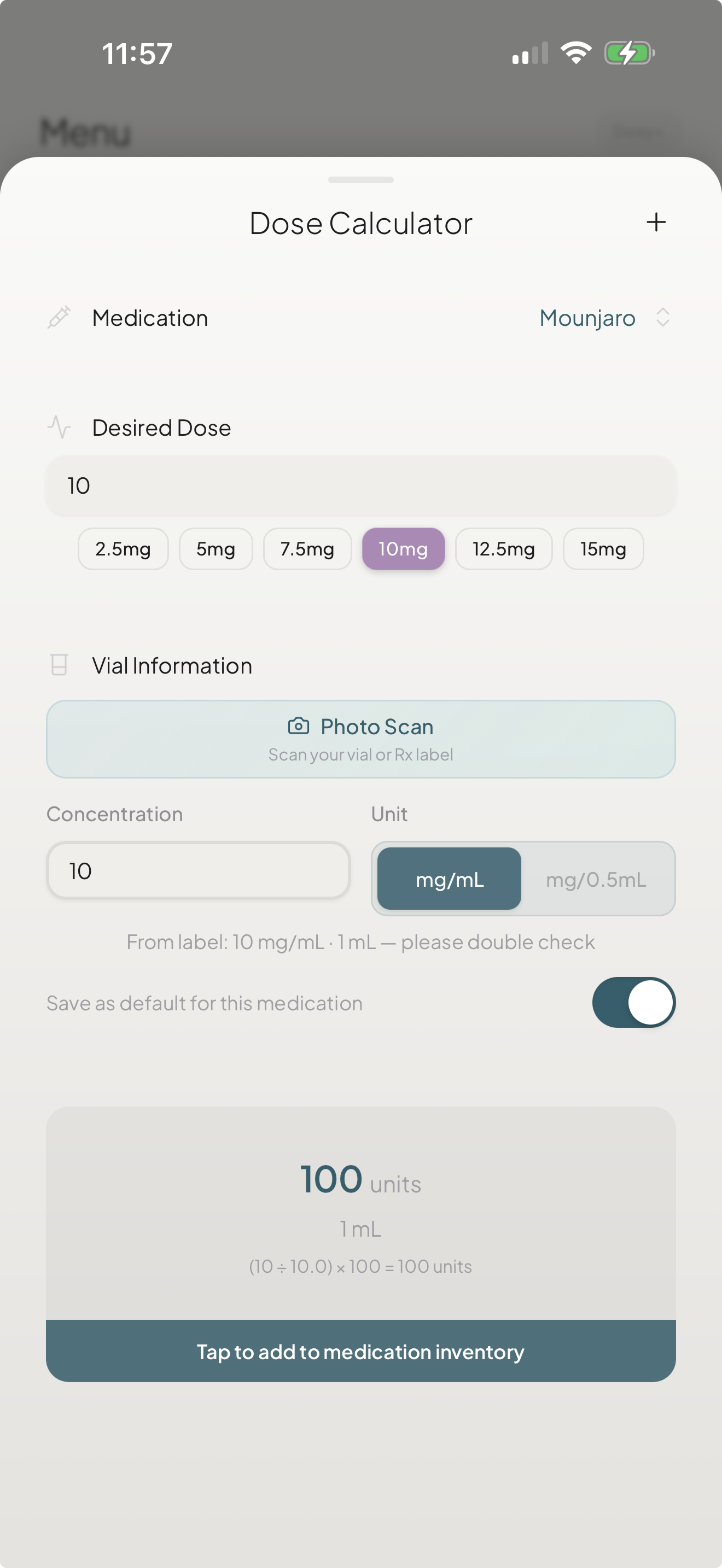
Dosy Dose Calculator for compounded GLP-1
All major GLP-1 molecules — Supports compounded semaglutide, tirzepatide, liraglutide, dulaglutide, and retatrutide with full dose calculation and inventory tracking.
Custom concentration entry — Enter your exact vial concentration (mg/mL) from your pharmacy label. Dosy uses it to calculate every dose.
Built-in dose calculator — Converts your prescribed milligram dose to syringe units based on your concentration. No manual math.
Vial inventory tracking — Tracks remaining volume in your vial automatically with each logged injection. Know exactly when you need a refill.
Injection site rotation — Smart rotation reminders help you avoid injecting the same site repeatedly.
Flexible dose logging — Log any dose amount at any frequency. Not locked to pre-set pen increments.
Educational

Understanding Concentration and Units

The number of syringe units you draw depends on your vial's concentration. For example:

• At a concentration of 5 mg/mL, drawing 10 units (0.1 mL) delivers 0.5 mg
• At a concentration of 2.5 mg/mL, delivering that same 0.5 mg requires 20 units (0.2 mL)
The formula:
Units to draw = (Dose in mg ÷ Concentration in mg/mL) × 100
⚠️
Important: This is a simplified illustrative example only. Always verify your specific dose, concentration, and draw volume with your prescribing provider and the label on your actual vial. Concentrations and syringe calibrations vary. Never adjust your dose without medical guidance.

Medical Disclaimer

Dosy Health is an educational and tracking tool only. It does not provide medical advice, diagnosis, or treatment recommendations. Compounded GLP-1 medications are not FDA-approved finished drug products.

Do not rely on any app, including Dosy, as a substitute for professional medical guidance. Always confirm your dose, concentration, and injection instructions with your prescribing provider and pharmacist.

Dosy Health is not affiliated with, endorsed by, or associated with Novo Nordisk (manufacturer of Ozempic®, Wegovy®, Saxenda®, and Victoza®), Eli Lilly (manufacturer of Mounjaro®, Zepbound®, and Trulicity®), or any compounding pharmacy.

Start Tracking Today

Free to use. Built for compounded and branded GLP-1 medications.

Download on the App Store
Get it on Google PlaySoon

Sources

  1. U.S. Food & Drug Administration. "Compounding and the FDA: Questions and Answers." FDA.gov
  2. U.S. Food & Drug Administration. "FDA's Concerns with Unapproved GLP-1 Products." FDA Drug Safety Communication, 2023.
  3. 21 U.S.C. § 353a (Section 503A) and § 353b (Section 503B) — Federal Food, Drug, and Cosmetic Act provisions governing pharmacy compounding.
  4. U.S. Food & Drug Administration. "Drugs@FDA: FDA-Approved Drugs" — Confirms compounded formulations are not FDA-approved finished drug products.